
Digital Playgrounds: Where Online Games Become Pedophile Hunting Grounds
An investigation into child exploitation on gaming platforms and the corporate failures that enable it

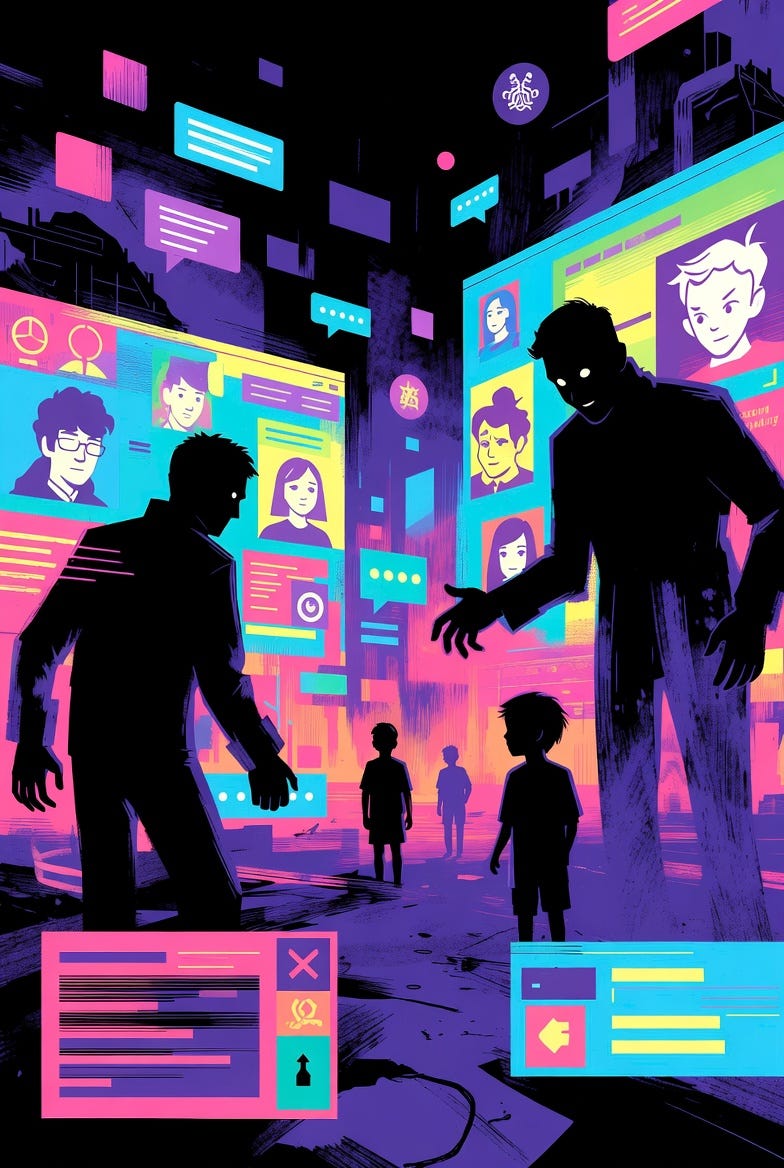
The Nine-Year-Old and the Promise of Virtual Currency
She was nine years old. She lived somewhere in the Inland Empire region of Southern California, and like millions of children her age, she spent her free time on Roblox, the massively popular online gaming platform where kids build worlds and play together.
Sometime in 2021, a man began messaging her through the platform. He presented himself as a teenager, someone who could be a friend. He offered her something enticing: Robux, the virtual currency that serves as social capital in the Roblox universe. With Robux, a child can buy avatar accessories, unlock premium games, and gain status among peers. For a nine-year-old, the offer must have seemed like a gift.
It was a trap.
According to federal prosecutors in the Central District of California, the man behind the screen was not a teenager. He was an adult from Ontario, California who had identified a vulnerable child on a platform marketed to families as safe. Over time, he escalated his demands. Using the virtual currency as leverage and employing increasingly coercive tactics, he pressured the girl to produce sexually explicit images of herself.
The FBI eventually traced the account back to him. In August 2022, a federal judge sentenced him to 25 years in prison for production of child pornography. The case made headlines briefly, then faded from public attention. But the platform where the grooming began, the one that promises parents their children will be protected, continues to host over 70 million daily users, the majority of them children.
This case is not an anomaly. It is a pattern.
The Scale of the Problem
Across six major platforms popular with young people, including Roblox, Minecraft, Fortnite, Discord, VRChat, and Rec Room, a review of federal criminal proceedings, regulatory enforcement actions, and civil litigation reveals a disturbing reality: the digital playgrounds where children spend hours each day have become documented hunting grounds for predators, and the companies that run them have repeatedly failed to stop it.
The numbers tell part of the story. Reports to the National Center for Missing & Exploited Children linked to Roblox skyrocketed from 675 in 2019 to over 24,000 in 2024. More than 100 families have filed lawsuits against Roblox alleging their children were groomed and abused through the platform, with thousands of additional claims under investigation. The Federal Trade Commission has extracted more than half a billion dollars in penalties from gaming companies for child safety violations. State attorneys general from New Jersey to Iowa to Tennessee have launched investigations and lawsuits.
But statistics alone cannot capture what happens to a child targeted through a video game. For that, you have to look at the cases themselves.
Roblox: The Platform That Profits While Children Pay the Price
Roblox describes itself as a place “powering imagination.” Its website features smiling children and assurances of safety. The company states that it employs thousands of moderators, uses artificial intelligence to filter inappropriate content, and provides parents with extensive controls to protect their kids. A significant portion of its user base is under 13 years old.
The nine-year-old girl from California was one of those users. Her case established a pattern that appears again and again in federal court documents: a predator finds a child on the platform, builds trust through gameplay and virtual rewards, then exploits the relationship to produce abusive material or arrange real-world contact.
In January 2024, federal prosecutors in Delaware unsealed an indictment against a man charged with traveling across state lines to sexually abuse an 11-year-old victim. According to court documents, the grooming began on Roblox and continued across multiple platforms, including Discord, TikTok, and Snapchat. The indictment charged him with coercion, enticement, and production of child sexual abuse material. The case illustrated a tactic that law enforcement sees repeatedly: predators start on heavily populated gaming platforms where children congregate, then migrate the conversation to less-moderated spaces to continue their abuse.
The same month, the Department of Justice announced charges against five leaders of a group called “Greggys’ Cult” for sexually exploiting children online. Prosecutors alleged that the group used both Discord and Roblox to find and groom their victims. The case revealed how predators operate not in isolation but in networks, sharing tactics and sometimes victims across platforms.
Roblox has responded to these cases by pointing to its safety investments. The company publishes transparency reports and has implemented features like stricter chat filtering for users under 13 and parental controls that can be managed remotely. Yet the lawsuits keep coming. State attorneys general from Iowa, Tennessee, Texas, and Louisiana have accused the company of creating a dangerous environment for children and failing to implement adequate protections.
The Tennessee Attorney General’s enforcement action goes further, alleging that Roblox was aware of the dangers on its platform while potentially scaling back investments in moderation and safety to reduce costs. A 2024 report by Hindenburg Research, a firm known for its investigations of corporate misconduct, described Roblox as a “pedophile hellscape” and alleged that the company’s trust and safety budgets were cut even as exploitation reports surged. The report claimed that outsourced moderators reported that a significant percentage of user complaints involved child grooming.
Perhaps most troubling is how Roblox has responded to the families seeking accountability in court. According to legal filings reviewed by Dolman Law Group, the company has attempted to force child abuse lawsuits into private arbitration, citing clauses buried in its terms of service. Victims’ families argue this would silence survivors, prevent public scrutiny of the company’s failures, and keep the scale of the problem hidden from view.
Fortnite and Minecraft: Where Predators Pose as Peers
In early 2026, federal prosecutors in the Eastern District of Pennsylvania announced the detention of a Delaware County man on 29 counts of child pornography offenses. According to the FBI, he had been preying on young boys through two of the most popular games in the world: Fortnite and Minecraft.
The tactics documented in the case were familiar to investigators who have seen this pattern before. The man posed as a peer, presenting himself as another young player rather than the adult predator he was. He offered in-game rewards to build trust and friendship. Then he escalated, using that trust to coerce his victims into producing explicit material.
Fortnite, developed by Epic Games, has become a cultural phenomenon with hundreds of millions of players. The company now offers a “Cabined Account” system that automatically restricts features like voice and text chat for users under 13. But these protections came only after the company paid a devastating price for its earlier approach.
In December 2022, Epic Games agreed to pay $520 million to settle FTC complaints, the largest penalty ever imposed in a case involving child privacy. The settlement included a record $275 million for violating the Children’s Online Privacy Protection Act. But the details of the case revealed something more damning than a privacy violation: evidence that the company knew its design was harming children and chose engagement metrics over safety.
The FTC complaint stated explicitly that Epic’s own employees had raised alarms about the dangers of enabling voice and text chat by default for all users, including children. The feature exposed young players to bullying, harassment, and contact from predators. But according to regulators, company leadership resisted turning the feature off because they feared it would reduce user engagement. The default setting that internal voices warned against remained in place until federal enforcement forced a change.
Minecraft operates differently but faces similar challenges. Microsoft’s Bedrock Edition integrates with the Xbox family account system, offering parents robust controls over communication, spending, and playtime. The official Minecraft Marketplace features curated content screened by Microsoft.
But the Java Edition of Minecraft allows players to connect to thousands of private servers where moderation standards vary wildly. On these servers, safety depends entirely on the diligence of individual server administrators, many of whom are volunteers without training or resources for child protection.
Microsoft’s broader ecosystem has faced direct regulatory accountability. In June 2023, the company agreed to pay $20 million to settle FTC charges that it violated COPPA by illegally collecting personal information from children under 13 who signed up for Xbox accounts, the same account system that underpins Minecraft’s safety features, without proper parental consent. The company retained children’s data even when parents failed to complete the consent process.
Discord: The Platform Where Grooming Continues
If you map the journey of a child targeted by an online predator, the pattern often looks the same: first contact on a gaming platform, then migration to Discord.
Discord is not a game. It is a communication platform, a place where communities form around shared interests through text channels, voice chat, and direct messages. It has become essential infrastructure for gaming culture, the virtual lobby where players coordinate before launching into their favorite titles. It is also, according to multiple Department of Justice prosecutions, the platform where predators take their victims to continue abuse away from the moderation systems of gaming platforms.
The Delaware man indicted for traveling to abuse an 11-year-old began his grooming on Roblox. He continued it on Discord. The leaders of Greggys’ Cult used Discord alongside Roblox to exploit children. The pattern is so consistent that one law firm described Discord and Roblox as functioning together as an exploitation pipeline.
Discord has implemented safety features in response to scrutiny. The company’s “Teen Safety Assist” initiative automatically blurs potentially sensitive images in direct messages from strangers and warns teen users when they receive a first message from an unknown account. A “Family Center” allows parents to monitor their teenager’s server activity and friend list, though not the content of their messages.
But in April 2025, the New Jersey Attorney General filed a lawsuit against Discord alleging that the company made deceptive claims about its safety practices. The complaint accuses Discord of misrepresenting the effectiveness of its parental controls and failing to adequately protect minors from harm.
Discord’s CEO, Jason Citron, was one of five tech executives called to testify before the Senate Judiciary Committee in January 2024. During his testimony, he emphasized that approximately 15 percent of his company’s employees work on trust and safety. When pressed by lawmakers about whether he would endorse pending federal safety legislation, he declined.
Like Roblox, Discord has been accused of attempting to force child abuse lawsuits into private arbitration, away from public courts where discovery could reveal internal documents about what the company knew and when.
VRChat: Dangerous by Design
In 2022, BBC reporters went undercover on VRChat, a social virtual reality platform where users can inhabit custom avatars and explore user-created worlds. What they found shocked child safety advocates.
According to the BBC investigation, reporters posing as children encountered rampant grooming behavior, exposure to virtual strip clubs and simulated sex acts, racist abuse, and explicit sexual harassment. Adults approached what they believed were children and engaged in overtly predatory behavior. The UK’s National Society for the Prevention of Cruelty to Children reviewed the findings and described VRChat as “dangerous by design.”
VRChat’s safety model differs fundamentally from traditional gaming platforms. Rather than implementing parental controls or age-gated restrictions, the platform relies on a “Trust System” where users are assigned ranks based on their behavior over time. Users can adjust their own privacy settings, block other users, or activate a “personal space” bubble that prevents other avatars from getting too close. But these tools require the user to protect themselves. There are no first-party parental controls. The platform advises parents to use the controls available on the underlying hardware like the Meta Quest headset.
The platform’s minimum age is 13, but this is enforced only through self-attestation at sign-up. A child who enters a false birth date faces no additional verification. The combination of high anonymity through customizable avatars, minimal moderation in private spaces, and a young user base that can easily circumvent age restrictions creates conditions that safety experts consider inherently dangerous.
VRChat has acknowledged the need for improvement and announced expansions to its Trust & Safety team. But the fundamental tension between the platform’s ethos of user freedom and the basic requirements of child protection remains unresolved.
A Different Model: Rec Room’s Approach
Not every platform has waited for scandal or regulation to prioritize child safety. Rec Room, a social gaming platform with a significant young user base, implemented a different approach from the start.
When a user signs up for Rec Room and indicates they are 12 or younger, the platform automatically creates a “Junior Account” with severe restrictions. Voice chat is disabled. Text messaging is disabled. Usernames are automatically generated to prevent children from sharing personal information. Access to any user-created content tagged for ages 13 and up is blocked. These restrictions are not optional settings that parents must remember to enable. They are the default, and they cannot be disabled by the child.
The effect is to create what safety advocates call a “walled garden,” a protected space where the highest-risk features, communication with strangers, are removed entirely for the youngest users.
Rec Room has earned independent certification from the kidSAFE Seal Program for its COPPA compliance. It has avoided the major public safety scandals, regulatory actions, and waves of litigation that have engulfed its peers. This is not because the platform is smaller or less popular. It is because the company made different design choices from the beginning.
The contrast with platforms that only implemented strong safety features after regulatory enforcement or public scandal is stark. Rec Room demonstrates that building a safer environment for children is technically and commercially feasible. The question is whether other companies will follow its lead voluntarily or only under compulsion.
What the Companies Knew
The most damning evidence in these cases is not what went wrong. It is what the companies knew before it went wrong.
The FTC’s case against Epic Games revealed that employees warned leadership about the dangers of default-on chat for children. The feature remained active until federal enforcement intervened. Microsoft collected data from children without proper parental consent through the Xbox account system for years before regulators caught up. Allegations in litigation and investigative reports claim Roblox was aware of escalating exploitation while reducing its safety investments.
These are not cases of companies blindsided by sophisticated criminals exploiting unforeseeable vulnerabilities. They are cases where corporations had information about risks to children and made decisions that prioritized engagement, growth, or cost savings over protection.
The pattern extends to how companies respond when accountability comes knocking. Attempting to force child abuse victims into private arbitration, declining to endorse federal safety legislation, fighting discovery requests that might reveal internal documents. These are the actions of companies working to limit their exposure rather than to understand and prevent the harms occurring on their platforms.
The Path Forward
For parents, the practical implications are clear but challenging. Parental controls exist on most platforms, but they are only effective if parents know about them, understand them, and consistently implement them. The platforms with the strongest safety records, like Rec Room and Fortnite’s Cabined Accounts, are those that default to protection rather than exposure. On platforms where safety features are optional, the burden falls on families to navigate complex settings menus and maintain vigilance over time.
The documented pattern of cross-platform migration means that protecting a child on one platform is not enough. Parents need to understand that a conversation that starts in Roblox or Fortnite may continue on Discord, Snapchat, or direct text messaging, away from whatever protections the original platform offered.
For policymakers, the record suggests that voluntary industry improvement has been insufficient. The largest safety improvements have come after regulatory action or the threat of it. Epic Games implemented Cabined Accounts after paying $520 million. Discord launched new safety features under threat of legislation and facing a state lawsuit. Companies have known about these problems for years. The changes came when the costs of inaction exceeded the costs of reform.
The children at the center of these cases, the nine-year-old offered Robux in exchange for her exploitation, the 11-year-old groomed across four platforms, the young boys targeted through Fortnite and Minecraft, did not choose to be part of this story. They logged on to play games. They found themselves in the crosshairs of predators who had learned to exploit systems that the companies behind those games had failed to adequately protect.
The platforms call themselves playgrounds. The evidence suggests they are something else: places where corporate design decisions, enforcement gaps, and business incentives have created documented pathways for the exploitation of children. The question now is what we intend to do about it.
Sources
U.S. Attorney’s Office, Central District of California: Inland Empire Man Sentenced to 25 Years
Department of Justice: Five Leaders of ‘Greggys’ Cult’ Charged
Federal Trade Commission: Epic Games to Pay More Than Half a Billion Dollars
Lawsuit Information Center: Roblox Child Sex Abuse Lawsuit Updates
Bloomberg: Roblox, Discord Scrutinized by States Over Child Safety
Senate Judiciary Committee: Testimony of Jason Citron, CEO of Discord
Good God. “pedophile hellscape” one lawmaker described ROblox as. If you have children and teens, and even if you don't, please share this article. Subcribe too...Consumer Diligence is going to many of the places others won't go. But they are places that need to be explored so you, and your children, can be safe.
I just read this as a parent and I’m honestly shaken.
I knew there were risks online, but seeing the actual federal cases laid out like this, seeing how often it starts in a game and then moves to private chat, is something else entirely. This isn’t a random story pulled from the internet. These are indictments, prison sentences, and documented patterns.
The part that hit me hardest was how normal it all begins. A message. A game. Virtual currency. Something that looks harmless.
If you have a child on Roblox, Fortnite, Minecraft, Discord, or any of these platforms, you need to read this. I thought I was paying attention. Now I’m realizing I didn’t understand the scale of what’s happening.
This is a wake-up call.